
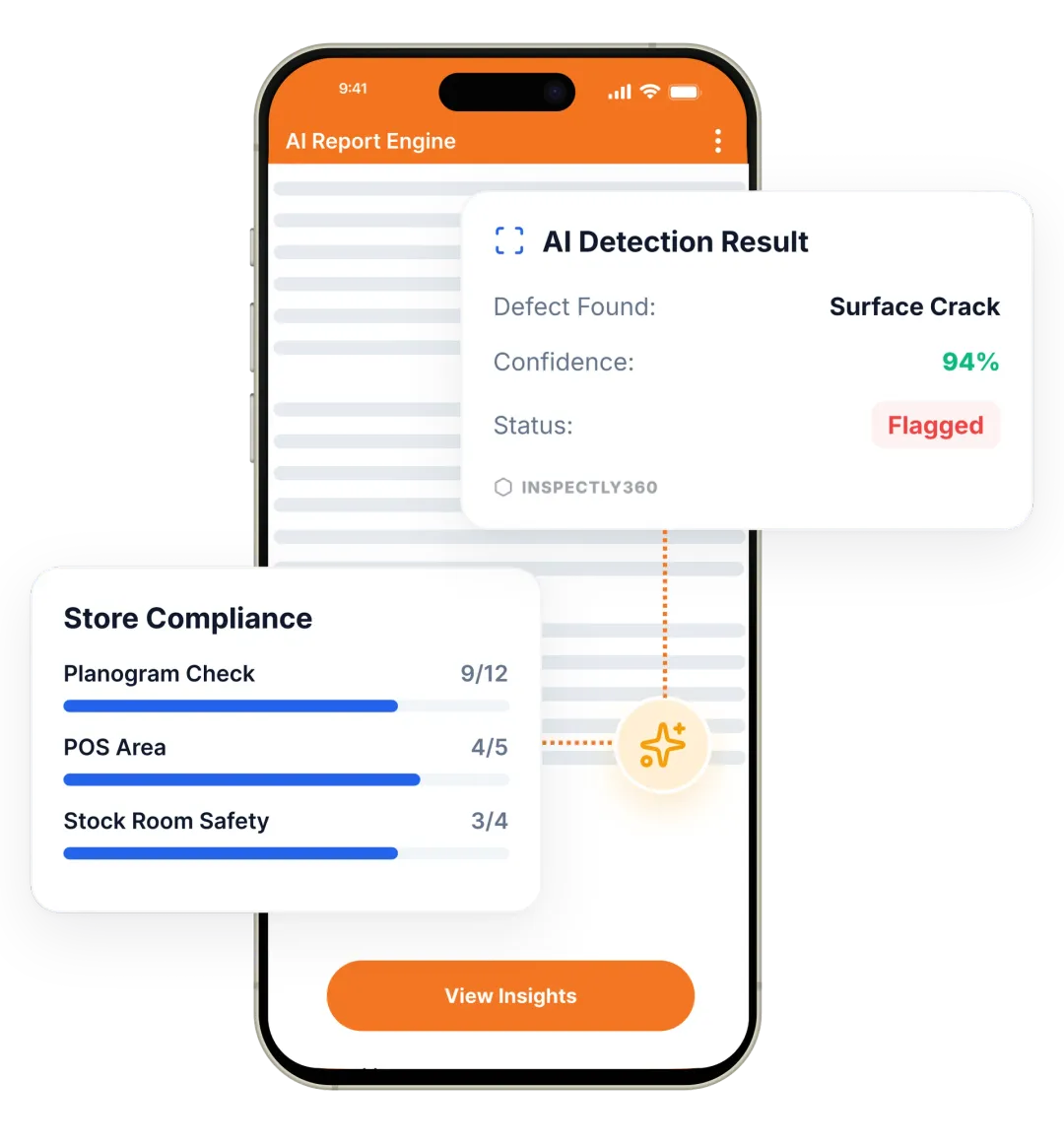
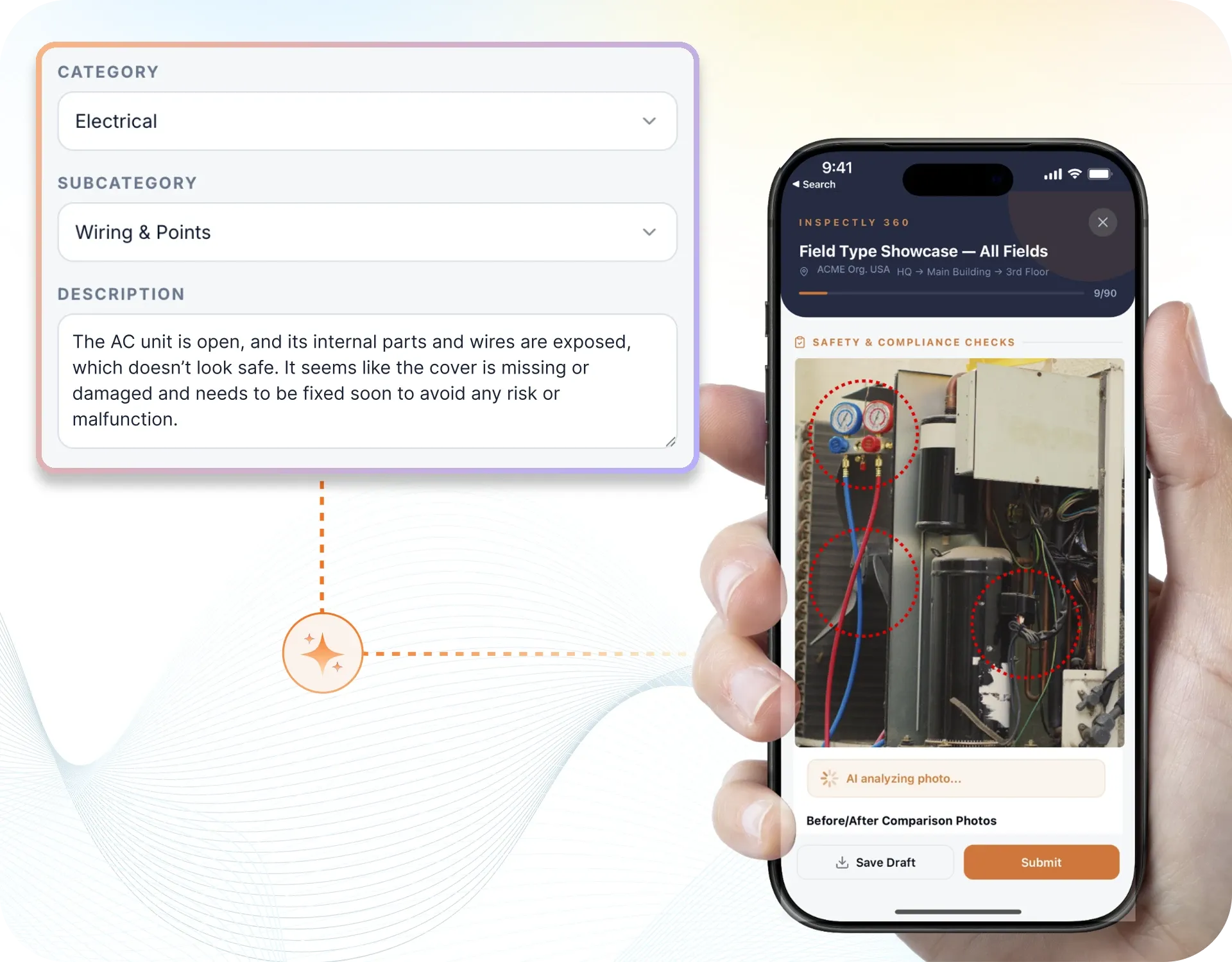
Take a Photo. AI Fills the Form
Your inspector takes a photo of any asset or defect. AI reads it and fills the inspection form automatically. No typing. No manual entry.

Water Treatment Plant (Municipal) Safety App helps safety teams catch water treatment plant (municipal) hazards before they cause an incident. Field teams log dosing out of range, filter breakthrough and high turbidity, low disinfection residual, analyser drift, attach photo evidence, and route every hazard to a named owner with a due date. Safety leads see open water treatment plant (municipal) hazards and overdue actions across every site on one dashboard.

Water Treatment Plant (Municipal) Safety App helps teams find and close water treatment plant (municipal) hazards before they cause an incident. Field teams log dosing out of range, filter breakthrough and high turbidity, low disinfection residual, analyser drift with photo evidence during a safety inspection, and every hazard is routed to a named owner with a severity and due date. Safety leads see open hazards and overdue actions across every site on one dashboard. Recurring hazards are flagged so root causes get fixed, not just the symptoms.
Water Treatment Plant (Municipal) Safety App targets the water treatment plant hazards that cause incidents: dosing out of range, filter breakthrough and high turbidity, and low disinfection residual. Field teams check coagulant and chemical dosing rates, clarifier and filter performance, disinfection residual and contact time, and online analyser calibration, log each hazard with a photo and a severity, and route it to a named owner, so a water treatment plant risk is caught and closed before it becomes an incident. Evidence stays aligned to drinking water quality standards and DSEAR for chemical storage.
A comprehensive water treatment plant inspection covers the key areas that affect safety and compliance. Monitor municipal water treatment plant safety issues with hazards and corrective action workflows. Your inspection should include sections for coagulant and chemical dosing rates, clarifier and filter performance, and disinfection residual and contact time, evidence capture, pass/fail or scoring criteria, corrective action assignment, and sign-off, so that nothing is missed and every inspection finding is traceable.
Catching water treatment plant (municipal) hazards early depends on a consistent routine. Follow these steps for each safety inspection:
A water treatment plant safety inspection checks coagulant and chemical dosing rates, clarifier and filter performance, disinfection residual and contact time, online analyser calibration, chemical storage and bunding, and sludge handling and backwash for hazards such as dosing out of range, filter breakthrough and high turbidity, and low disinfection residual. Water treatment operators log each hazard with a photo and a severity, route it to an owner, and track it to verified closure, so a water treatment plant risk is fixed before it causes an incident.
Templates align to drinking water quality standards, DSEAR for chemical storage.

Field teams check the water treatment plant for dosing out of range, filter breakthrough and high turbidity, low disinfection residual, analyser drift.

Each water treatment plant (municipal) hazard gets a severity, a named owner, and a due date.

Risk dashboards flag recurring water treatment plant (municipal) hazards so root causes get fixed.
Everything your field team records during water treatment plant (municipal) safety, from photos and voice notes to sign-off, InspectWrk turns into a finished report automatically. Faster, more accurate, and without the retyping.
Your inspector takes a photo of any asset or defect. AI reads it and fills the inspection form automatically. No typing. No manual entry.
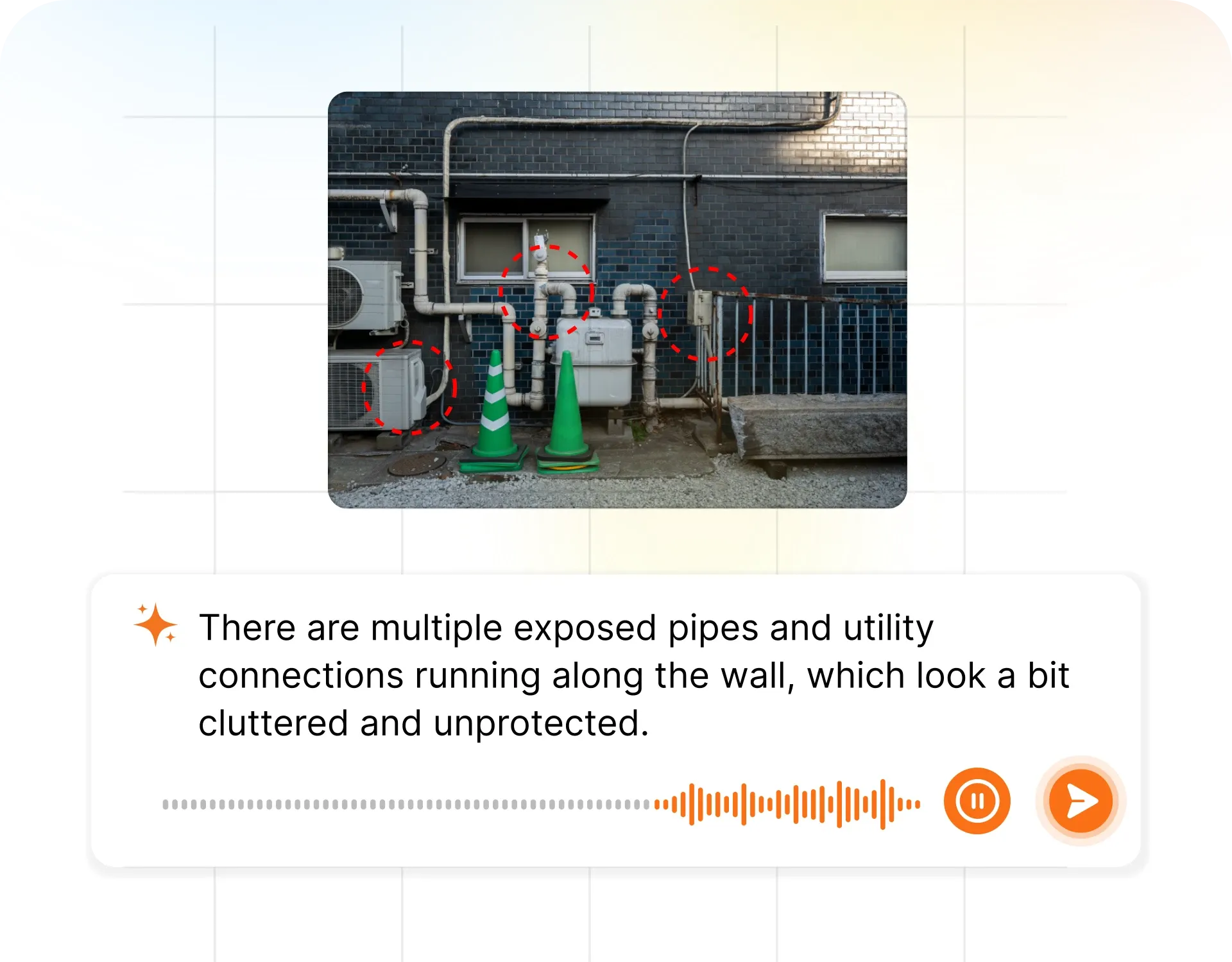
Inspectors speak their observations in any language. AI transcribes and fills the form in real time. Completely hands-free in the field.
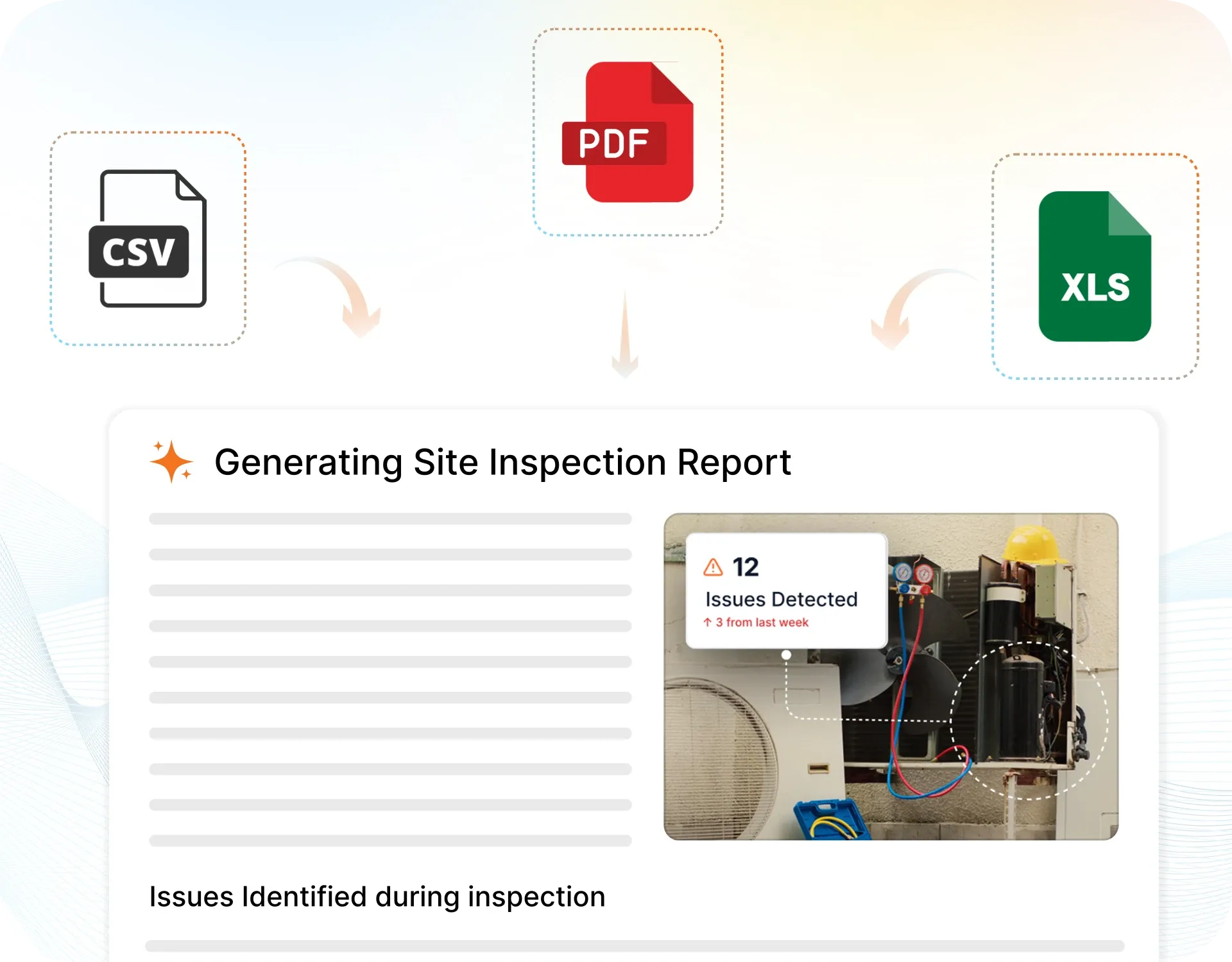
The moment an inspection is submitted, a branded PDF, Excel, or CSV report generates automatically. No manual work. No waiting.
InspectWrk integrates with the tools your team already uses, including Zoho, Microsoft 365, and SAP. No double entry.
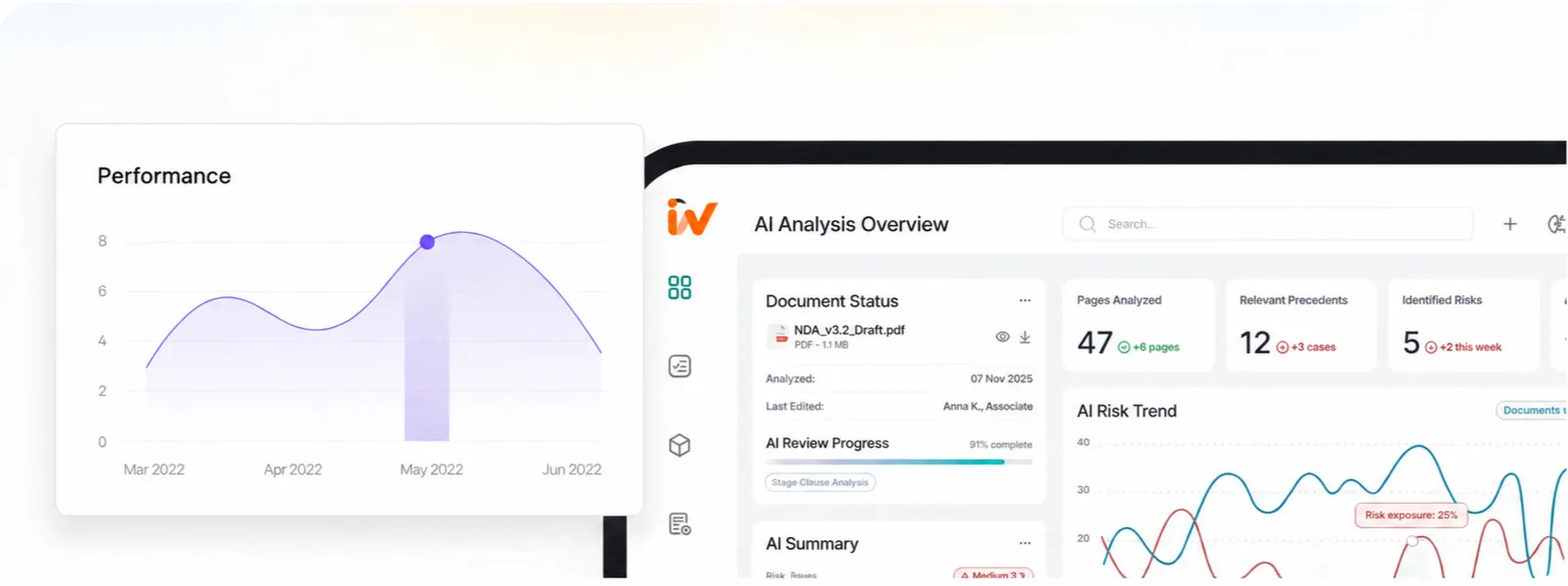
Your operations team sees completion rates, open issues, and compliance scores across all sites in real time. No chasing updates.
From data collection to compliance: see how teams use InspectWrk for every use case.
Capture field data once with digital forms that work even offline.
Explore use caseRun standardized inspections with photos, scoring, and instant reports.
Explore use caseConduct structured audits with evidence trails and pass or fail scoring.
Explore use caseLog hazards, near misses, and safety checks from any job site.
Explore use caseCatch defects early with repeatable quality checks and sign off.
Explore use caseReport incidents in the moment with photos and follow up actions.
Explore use caseInspect assets and keep condition and inspection history per asset.
Explore use caseRun preventive maintenance checks and log repairs with photo evidence.
Explore use caseStay audit ready with logged checks, timestamps, and shareable reports.
Explore use caseWater Treatment Plant (Municipal) work breaks down the moment evidence leaves the form. These are the problems Water Treatment Plant (Municipal) Safety App is built to remove, and what the team gets back when it does.

Dosing out of range, filter breakthrough and high turbidity, low disinfection residual, analyser drift on the water treatment plant are fixed, then reappear weeks later. Each water treatment plant (municipal) defect is treated as fresh because nobody sees it is the third time this quarter. The water treatment plant root cause is never addressed.
Problem
Solution

Some water treatment plant (municipal) records sit in Excel, some in a WhatsApp group, some in a folder of photos. There is no single source of truth for the water treatment plant, so every water treatment plant (municipal) question takes an hour and three people to answer.
Problem
Solution

Someone photographs a hazard and posts it in a group chat. It scrolls away. A few weeks later the same hazard, dosing out of range, filter breakthrough and high turbidity, low disinfection residual, analyser drift, causes a near-miss, and nobody connected the two.
Problem
Solution
Every hazard logged in Water Treatment Plant (Municipal) Safety App gets a photo, a severity, and a named owner with a due date the moment it is reported. It does not scroll away in a chat thread. Field teams capture dosing out of range, filter breakthrough and high turbidity, low disinfection residual, analyser drift during a check, and the most urgent risks surface first because severity drives the dashboard order. Overdue safety actions escalate automatically. Recurring issue detection flags when the same hazard keeps appearing on the same water treatment plant, so the team fixes the root cause instead of treating the symptom again. Safety leads see open hazards and overdue actions across every site on one dashboard, which is the visibility a verbal report or a WhatsApp photo can never give.
InspectWrk captures every water treatment plant (municipal) safety record with timestamps, photo evidence, and structured fields aligned to drinking water quality standards and DSEAR for chemical storage. Each round produces a digital trail per water treatment plant and per site, so when an auditor or authority asks for proof, your team produces it in seconds rather than days. Templates can be configured for the specific schedule and frequency required at each site, and dashboards surface upcoming statutory due dates and overdue rounds alongside operational data. The result is a single defensible record per round, not a folder of photos and a chat thread.
Yes. The Water Treatment Plant (Municipal) Safety App is offline-first by design. Inspectors download their assigned rounds before going on site, then complete forms in low-signal areas on site without any network connection. Photos, voice notes, geotags, and form fields all save locally on the device. When the phone or tablet returns to coverage, submissions sync automatically in the background, with no action from the inspector. Sync is incremental and conflict-aware, and each submission shows a clear synced or pending indicator, so nothing is silently lost between the field and the office and large photo sets upload reliably over weak connections. Local validation flags incomplete sections before submission so nothing is missed. This matters in real field environments where signal drops are routine in the very places that need the most evidence.
Every submission carries a timestamp, the inspector's identity, an optional geofenced location, and the full set of answers, photos, and voice notes attached to that round. Failed water treatment plant (municipal) safety items create issues with severity, owner, and verified closure photos. Reports generate automatically as branded PDFs with the site, the water treatment plant, and finding details. Because water treatment plant (municipal) safety evidence is captured at the point of work rather than written up afterwards, the chain from finding to verified fix stays intact and is hard to dispute later. When an auditor or client asks for proof of a water treatment plant (municipal) safety round, your team searches by site, asset, or date and produces a complete digital record in seconds. The same evidence supports drinking water quality standards and DSEAR for chemical storage documentation requirements where relevant.
Every failed item can spawn a corrective action with a named owner, due date, severity, and photo proof requirement on closure. Water testing and plumbing service partners receive notifications, see their open actions in the app, and submit verified closure photos before the action closes. Dashboards show open and overdue actions per site, per contractor, and per audit cycle, so leadership can see whether issues are actually closing or just sitting in a backlog. Contractor performance scoring tracks closure speed and re-open rate over time, so operations managers can compare contractors and service partners objectively before assigning the next site.
Yes. A single InspectWrk instance covers every site in your portfolio. Each site has its own assets, templates, contractors, and rounds, but the operations manager sees one live dashboard with completion rates, open issues, and risk score by site. Configurable dashboards show which sites had problems and which rounds are overdue, and scheduled reports reach managers before the day starts, replacing the Monday morning task of manually compiling reports from spreadsheets and chat threads. New sites inherit your standard templates the moment they are added, so the portfolio scales without rebuilding the process for each location.
AI handles the paperwork while the inspector handles the physical water treatment plant (municipal) safety check. Photo analysis compares each water treatment plant (municipal) safety photo with the template's reference standard and flags deviations to confirm. Voice-to-text lets the inspector speak water treatment plant (municipal) safety observations in their own language, and the form fills itself. AI smart suggestions classify the issue type, severity, and location from what the inspector captures, with a one-tap confirm or override. The qualified inspector stays in control of every water treatment plant submission. Time on site drops, typing in the field disappears, and the data captured is more consistent across teams.
Recurring issue detection in Water Treatment Plant (Municipal) Safety App continuously analyses safety submissions across every site. When the same hazard keeps appearing, the same defect type on the same water treatment plant or in the same zone, it is flagged as a recurring problem with its frequency, the sites affected, and the trend direction. This is the difference between closing the same hazard ten times and fixing it once. Safety leads see recurring hazards surfaced on the dashboard alongside open and overdue actions, so root-cause work is prioritised by evidence rather than by whoever shouted loudest. Compliance risk scoring then highlights which sites are trending toward a safety failure before an incident or an inspector makes it obvious.
Explore other inspection and audit apps for professional services teams.
Last updated: