InspectWrk

Healthcare Facility Inspection Software for Patient Safety & Compliance.

Maintain Joint Commission and CMS readiness with infection control audits, facility cleanliness inspections, medical equipment checks, and regulatory compliance documentation. InspectWrk helps healthcare organizations deliver consistent patient safety standards, simplify survey preparation, and reduce compliance risks across every department and facility.

Built for
Wards, theatres & biomedical
Works
Offline
Reports
PDF + Excel

Templates aligned to Joint Commission, CMS and NABH standards.

Smiling medical staff standing together inside a modern hospital

Where hospital teams lose hours every week.

The same four gaps come up in almost every hospital we talk to. Here is how each one closes.

NABH audits require manual prep

NABH audits require extensive manual preparation across nursing, EVS, and biomedical departments. The team scrambles for weeks before every cycle.

With InspectWrkEvidence is captured against each standard, so survey prep is a filter.

Biomedical equipment records are fragmented

Biomedical equipment records live in three different spreadsheets, one per department. NABL traceability per asset is missing when the surveyor asks.

With InspectWrkEvery device has one record with its PPM and calibration history.

Maintenance logs hard to verify

Maintenance logs and ward round records are difficult to verify after the fact. There is no timestamp or photo evidence per check, so the audit becomes a trust exercise.

With InspectWrkEach check carries a timestamp and a photo, so records verify themselves.

Audit trails are incomplete

Biomedical waste, infection control, and PPM checks are tracked in different places. The auditor wants one trail; what they get is a stack of folders.

With InspectWrkOne audit trail covers waste, infection control and PPM, filtered to any standard.

Every check across the hospital.

Pick the work you run today. Each one starts from a ready template you can edit.

  • Environment of Care Rounds

    Run EOC rounds the same way in every department.

    Includes: Joint Commission EOC alignment, Department-level tracking, Photo-documented findings, Trend analysis and improvement plans

    Conduct systematic Environment of Care (EOC) rounds aligned with Joint Commission standards. Inspect patient care areas, public spaces, utility systems, and safety equipment with standardized digital checklists and photo documentation.

    See the Environment of Care Rounds Master Template
  • Infection Control Environmental Audits

    Verify cleaning in every room and theatre.

    Includes: HAI reduction documentation, Cleaning verification tracking, ATP testing integration, Outbreak investigation support

    Verify cleaning and disinfection standards in patient rooms, operating theaters, sterile processing, and common areas. Track cleaning agent usage, contact times, and ATP testing results digitally.

    See the Infection Control Environmental Rounds Template
  • Medical Equipment Inspections

    Keep a full history for every device.

    Includes: Complete device inspection history, PM scheduling and tracking, Calibration documentation, Recall management support

    Track biomedical equipment inspections, preventive maintenance, calibration checks, and safety testing across every department. Maintain complete device histories for regulatory compliance.

    See the Biomedical Equipment Inspection Preventive Maintenance Checklist Template
Doctor with glasses and stethoscope reading heart monitor data on a tablet beside a hospital bed

Finding to closed action, in just 5 steps.

No re-keying between the ward, facilities and quality. Each step hands over to the next on its own.

See It on Your Site
  1. Step 01

    Inspect

    The round finds an issue and adds a photo.

    • Fire door
    • Fail
  2. Step 02

    Log

    A finding opens with the ward and the standard.

    • EOC-0119
    • High
  3. Step 03

    Assign

    The fix goes to facilities with a due time.

    • Facilities
    • Due today
  4. Step 04

    Fix

    The team fixes it and adds a photo.

    • Photo added
    • Fixed
  5. Step 05

    Verify & report

    Quality signs it off and the record is filed.

    • Closed
    • PDF

Every step is time-stamped and signed, so the audit trail builds itself.

How does inspection software keep a hospital ready for an unannounced survey?

An NABH assessor can arrive on a schedule that leaves no room for a last-minute scramble, so readiness has to be continuous. In many hospitals the evidence for an NABH audit checklist sits in paper files across nursing, housekeeping, and Biomedical Engineering, so every assessment begins with a hunt. Records are scattered, there is no single audit trail, and compliance becomes a feeling rather than a fact. Healthcare facility inspection software keeps the evidence current and structured, so readiness holds between assessments.

With InspectWrk, ward round inspection, infection control audit, housekeeping audit, sterile zone verification, biomedical equipment inspection, and PPM hospital rounds run on digital templates aligned to the standards, on a schedule. Biomedical waste management is tracked against the Bio-Medical Waste Management Rules, and radiology safety checks align to AERB. Every finding is captured with photos, timestamps, and attribution, and corrective actions are tracked to verified closure.

When an assessor asks for evidence, the answer is a filter rather than a search across departments and binders. The platform maps records to NABH, NABL compliance and ISO 15189 for the labs, the Clinical Establishments Act, IPC infection-control practice, and JCI where a hospital pursues it. Compliance dashboards show finding trends and overdue items, so leaders see where readiness is slipping in advance and walk into an assessment with a complete, evidenced trail.

If you are comparing inspection platforms for healthcare compliance, it helps to see how each handles proof and corrective actions.


Compare Inspectwrk and Safetyculture for Compliance Inspections

AI turns every inspection into a ready report.

Submit an inspection and AI writes the PDF report and Excel sheet for you. No admin, no waiting.

01 / 05Photo to formVISION AI

Take a Photo. AI Fills the Form.

Your inspector takes a photo of any asset or defect. AI reads it and fills the inspection form automatically.

No typing. No manual entry.

02 / 05Voice to textVOICE AI

Speak. AI Writes It Down.

Inspectors speak their observations in any language. AI transcribes and fills the form in real time.

Completely hands-free in the field.

03 / 05Auto reportsREPORT AI

AI Writes the Report. PDF and Excel, Instantly.

The moment an inspection is submitted, AI summarises the findings and builds a branded PDF report and an Excel sheet for you.

No manual reporting. No copy-paste.

04 / 05IntegrationsINTEGRATIONS

Connect Your Existing Tools.

InspectWrk integrates with the tools your team already uses, including Zoho, Microsoft 365, and SAP.

No double entry.

05 / 05Live dashboardLIVE DATA

Live Dashboard. Every Site. Always On.

Your operations team sees completion rates, open issues, and compliance scores across all sites in real time.

No chasing updates.

See how operations teams standardize work in the field.

Real-world inspection workflows built around consistency, evidence and faster follow-up.

Explore Customer Stories
Case study 01 of 05

Start with a healthcare template.

Free checklists and apps built for hospitals and clinics. Use them as they are or change any field.

  • Doctor in a white coat filling in a form on a tablet with a stylusEnvironment of CareFree Template

    Environment of Care Checklist

    This Environment of Care checklist supports hospital teams in assessing safety and compliance across patient care areas. It covers corridors ...

  • Young doctors in white uniforms walking along a bright hospital corridor, one reading a blue folderInfection ControlFree Template

    Infection Control (Dentistry)

    Containing infections is essential in the field of dentistry. This course will explain the procedures and practices to control and ...

  • Doctor in a white coat with crossed arms holding a stethoscope against a blurred hospital backgroundInfection ControlFree Template

    Hand Hygiene Checklist

    Infection control nurses use this inspection for hand hygiene to verify hand condition and safety controls, hygiene verification and compliance records and photo evidence, capture photo evidence on every finding, and track corrective actions to verified closure, building the evidence health-care teams need for NABH, NABL and Bio-Medical Waste Management Rules.

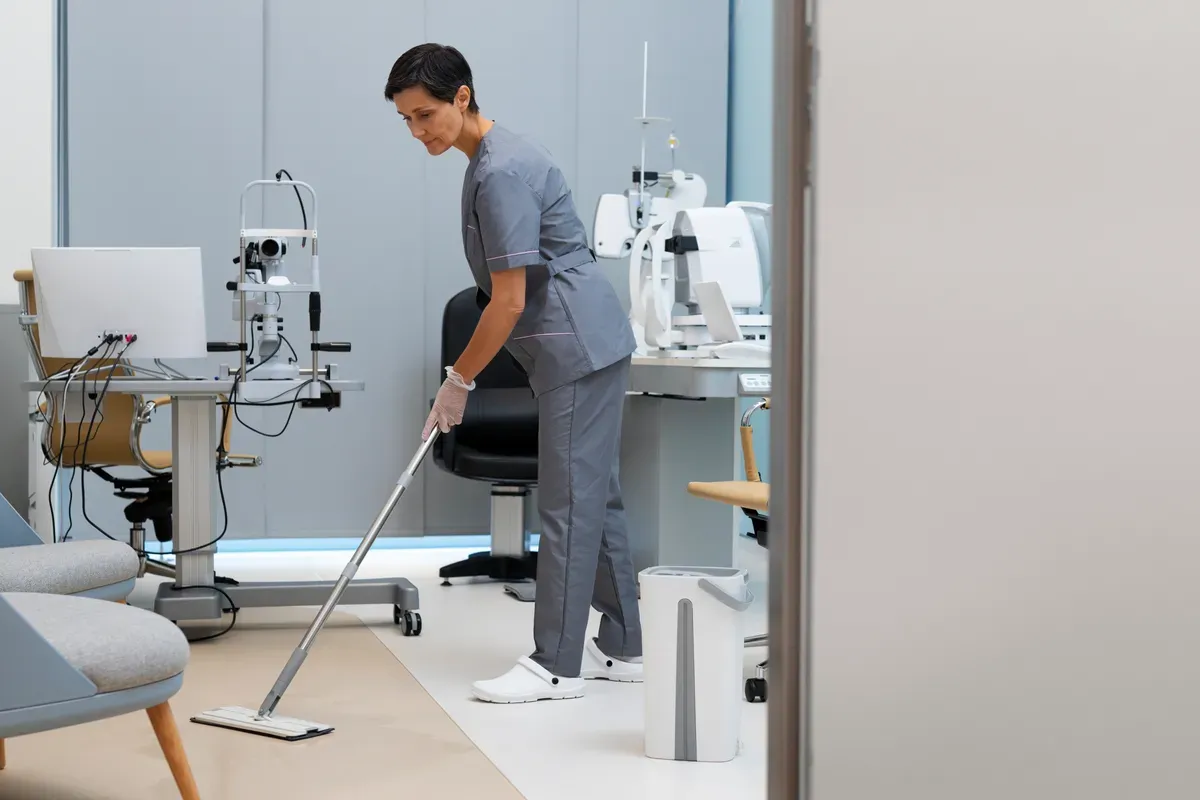
  • Cleaner in grey uniform mopping the floor of an eye clinic examination room with equipmentInfection ControlFree Template

    Sterile Processing Checklist

    SPD managers verify decontamination, inspection, assembly, sterilization and storage against AAMI ST79, checking instrument cleanliness, tray integrity and cycle records. Log findings with evidence and track corrective actions to closure to protect the sterile supply chain.

Questions from healthcare teams

See it on your own ward rounds in a 30-minute demo.

Book a Free Demo

Yes. InspectWrk maintains HIPAA compliance with encrypted data storage, access controls, audit logging, and Business Associate Agreements. Importantly, facility, safety, and equipment inspections do not require protected health information: inspectors document conditions, compliance, and equipment, not patient data. That keeps the compliance footprint small while still giving healthcare organizations a full digital trail for Environment of Care rounds, infection control audits, and biomedical equipment checks. Role-based access ensures each team sees only its relevant inspections. Security documentation is available to support vendor risk assessments, which hospital procurement and IT teams typically require before approving a new platform. The result is a system that meets healthcare governance requirements without adding patient-data risk to your inspection program.

Yes. In InspectWrk each department can run its own inspection templates, schedules, and reporting. Nursing, Environmental Services, Facilities, and Biomedical Engineering each see only the workflows and data relevant to them, while leadership dashboards roll results up to facility or health-system level. Role-based access and template assignment keep inspections organized by department, so an infection control round and a biomedical PPM check do not get tangled together. You can still publish templates that apply across the whole organization where a standard must be identical everywhere. This structure mirrors how hospitals actually operate, with distinct teams accountable for distinct standards, while still giving quality and safety leaders a single view of survey readiness across every department and site.

Yes. InspectWrk integrates with healthcare CMMS platforms such as TMS and Nuvolo, and it can connect to EHR systems where equipment location or asset data is needed. API access supports custom integrations, so inspection findings, work orders, and compliance data move between InspectWrk and your existing healthcare systems without manual re-entry. A biomedical equipment fault found on a round can become a work order in your CMMS automatically, which closes the common gap where inspection findings never reach the maintenance system. Business Associate Agreements and security documentation are available to support the vendor risk assessment your IT team will run. The aim is to add reliable field inspection data to the systems you already operate, not to replace them.

Most healthcare systems are operational within two to four weeks. The implementation team provides pre-built templates aligned with Joint Commission and common Environment of Care requirements, training for administrators and inspectors, and configuration support. A phased rollout by facility or by department is supported, so you can start with one hospital or one team, confirm the workflow, then scale at your own pace while maintaining survey readiness throughout. Because inspectors already know how to use a phone, training is short, which drives the adoption that makes a compliance program actually work. Custom CMMS integrations and portfolio-wide template standardization are handled during the same rollout, so you reach a consistent inspection standard across every site without a long project.

NABH accreditation assessments and Joint Commission or CMS surveys can happen on a schedule or at short notice, so InspectWrk is built around continuous readiness rather than pre-survey scrambling. Facility rounds, life-safety checks, biomedical equipment checks, and infection-control audits run on digital templates aligned to the relevant standards, whether NABH and NABL in India or Joint Commission and CMS elsewhere, on a schedule with photo evidence and timestamps on every finding. Corrective actions are tracked to verified closure, so you can show an assessor not only that a deficiency was found but that it was resolved and confirmed. Because every inspection, finding, and corrective action lives in one system, the evidence an assessor asks for is a filter away rather than a search across departments. Compliance dashboards show finding trends and overdue items, so leaders see where readiness is slipping before an assessor does, and the team walks into an accreditation visit or survey with a current, complete, evidenced trail.

Yes. InspectWrk keeps a complete inspection and maintenance history for each biomedical asset in one place, rather than split across separate spreadsheets per department. Preventive maintenance, calibration checks, and electrical safety testing run on schedule, and each completed check is recorded against the specific device with photos, readings, and the technician's sign-off. When a survey or an incident review asks for traceability on a particular device, the full record is available immediately. Automated scheduling generates the next PM or calibration task on time, so checks are not missed because a renewal date sat unnoticed in a file. Recall management is easier too, because you can identify and locate affected devices quickly. The result is one verifiable equipment record that holds up to NABH, Joint Commission, and CMS scrutiny.

Explore other industries.

Every industry gets its own checklists, apps and workflows, all on the same platform.

Updated