
“InspectWrk transformed how we manage site safety inspections. The offline capability alone saved us countless hours. Our compliance rate jumped from 72% to 96% in just three months.”
Sarah Mitchell
Meridian Construction Group

Looking for document control software built around how your quality team governs documents? We provide it. InspectWrk delivers a tailored document control solution on our platform, configured to your approval and revision workflow. Book a demo to scope it.
Document control software governs controlled documents through their lifecycle: creation, review, approval, revision, distribution, and retirement, with a full audit trail. InspectWrk provides a document control solution tailored to your operation, built on our records and workflow platform and configured to your document types, approval workflow, and review cadence.
When controlled documents live in shared folders and email, the wrong version gets used, approvals are informal, obsolete versions stay in circulation, reviews are missed, and when an auditor asks who approved a procedure and when, there is no clear record. Generic file storage does not control documents; it just stores them.
We deliver your document control solution in five steps, from scoping your workflow to rollout and support.
We map your controlled document types, approval workflow, and review cadence, so the solution matches how your organisation actually governs documents.
We build creation, review, approval workflows, and version control on the platform, so every document has a controlled lifecycle.
We configure controlled access, distribution, obsolete-version control, review schedules, and audit trails, so the right version is used and old ones are retired.
You run the solution on one document set, so approval, version control, and distribution are proven before it scales.
We roll the solution across your documents and support it, with document status and audit trails live for your quality team.
Document control covers the controlled-document lifecycle: creation, review, approval, version control, distribution, obsolete-version control, review schedules, and audit trail. The scope below is what the platform runs, distinct from generic file storage and the broader quality system.
InspectWrk is the document control layer within or beside your quality system, not generic file storage. Your QMS holds the broader quality processes. InspectWrk owns the controlled-document lifecycle: approval workflows, version control, obsolete-version control, review schedules, and audit trail. Documents link back to the processes and areas they govern, so document control and its evidence sit within your quality system without duplicating your file storage.
Validate four things during the pilot rather than after. First, that documents move through review and approval with recorded sign-off. Second, that version control ensures the current approved version is used. Third, that obsolete versions are retired and reviews are scheduled. Fourth, that a full audit trail is produced for an auditor. Run one document set so the approve, control, and audit loop is proven before it scales.
Controlled documents govern how work is done, so their integrity matters. InspectWrk enforces role-based access so authors draft, approvers approve, and users access the current version, with obsolete versions controlled. Creation, approvals, revisions, and distribution are logged and retained for the period your quality and audit teams require, so any claim about a document's approval or version can be traced to its evidence with time and author preserved.
A document control rollout works best document set by set rather than all at once. Start with the controlled documents where the risk of using the wrong version is highest, prove the approve, control, and audit loop there, then extend. Existing documents import so teams do not start empty. Because the configuration is workflow rather than code, each document type can carry its own approval and review rules while document status rolls up to one view for quality leadership.
What Document Control Software covers for your team.
Teams comparing InspectWrk to shared folders and email for documents see the difference on five points: version control, approval, obsolete versions, reviews, and audit trail.
| Capability | Without InspectWrk | With InspectWrk |
|---|---|---|
| Version control | The wrong version gets used, so people work to out-of-date documents. | Version control ensures the current approved version is the one in use. |
| Approval | Approvals are informal, so there is no record of who approved what and when. | Approval runs as a workflow, so every approval is recorded with owner and date. |
| Obsolete versions | Obsolete versions stay in circulation, so superseded documents are still followed. | Obsolete versions are controlled, so retired documents cannot be used by mistake. |
| Reviews | Reviews are missed, so documents drift out of date without anyone noticing. | Review schedules ensure documents are reviewed on cadence and kept current. |
| Audit trail | When an auditor asks who approved a document, there is no trail. | A full audit trail shows creation, approval, and revision history on demand. |
Manage every checklist in one connected workspace, capture evidence on mobile at the point of work, and let AI turn field inputs into clear, stakeholder-ready reports in minutes.

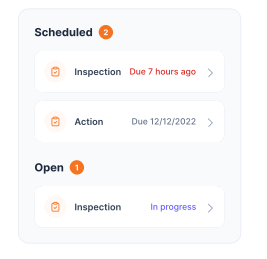
See which checklists your team has in progress across every site, jump into the same inspection with one tap, and keep field, supervisor, and back-office views in sync without sending screenshots on WhatsApp.


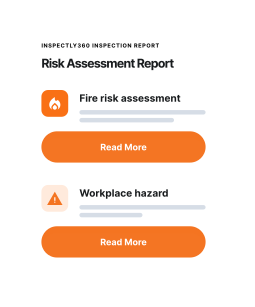
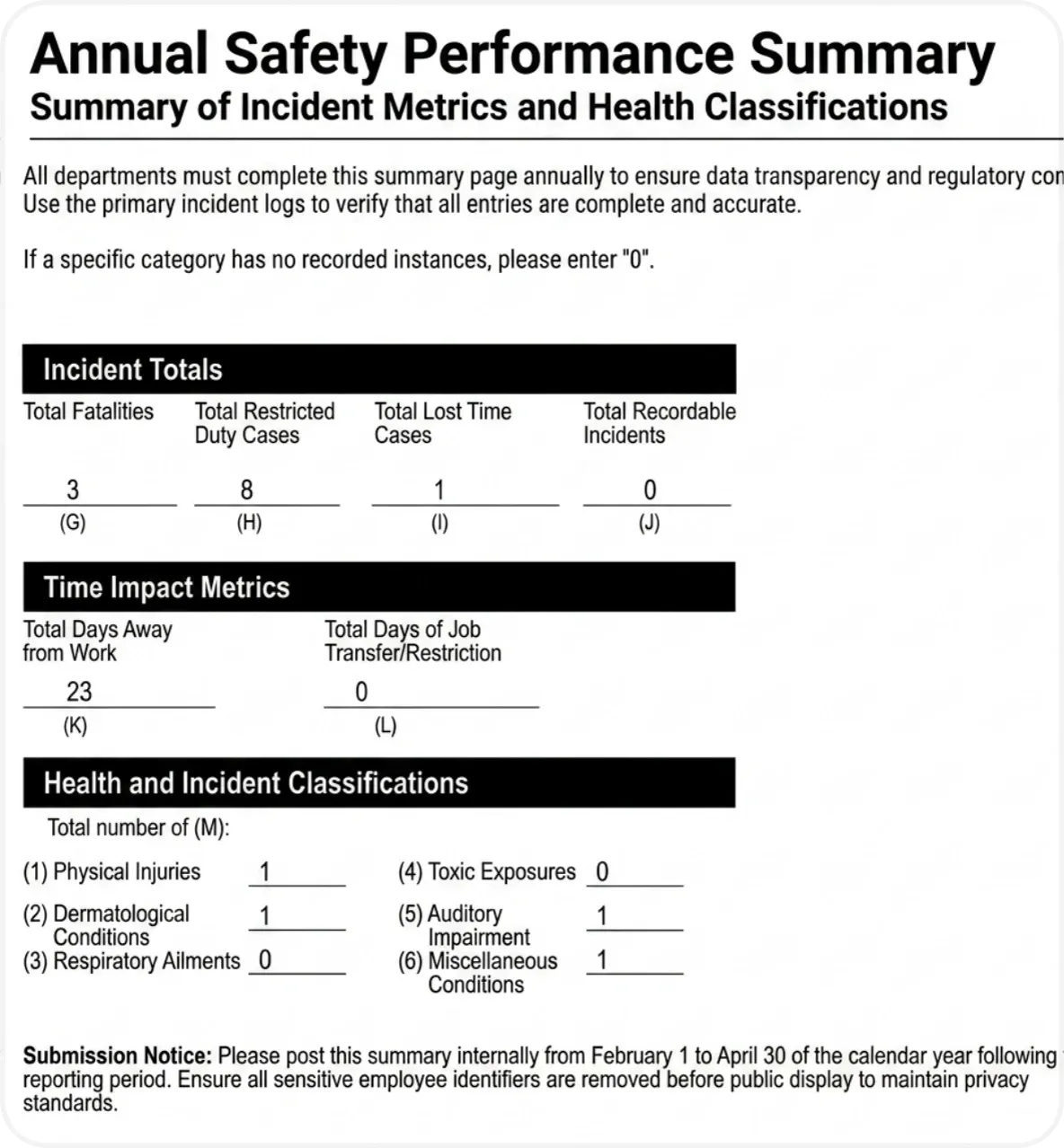


Every team reports differently. Build the report your operations, quality, or compliance leads actually want to read, share it as a branded PDF, and schedule delivery to the stakeholders who need it.


See completion, pass rate, and recurring findings across every checklist and every site, without pulling spreadsheets together at the end of the month.
What changes once document control software is standardised on InspectWrk.




“InspectWrk transformed how we manage site safety inspections. The offline capability alone saved us countless hours. Our compliance rate jumped from 72% to 96% in just three months.”
Sarah Mitchell
Meridian Construction Group

“The AI-powered defect detection has changed how we work. Our inspectors capture photos and the system flags issues we'd have missed. It's like having an expert reviewer on every site visit.”
James Chen
Pacific Manufacturing Co.
“Rolling out digital checklists across multiple projects gave us instant visibility into recurring safety issues. We now resolve critical findings in hours instead of days.”
Olivia Carter
Northbridge Infrastructure
Get started with inspection and audit checklist templates.

This Gap Analysis ISO 9001 Checklist can help you prepare for ISO 9001:2015 certification. Use this to evaluate if ...

This ISO 45001 readiness checklist can help you identify areas of your business that require further work before your external ...
Document control is not file storage, and it is a specific part of a quality system. Generic cloud storage holds files but does not control them: it does not enforce approval before a document is used, prevent the wrong version being followed, retire obsolete versions, or prove who approved what and when. Document control software governs the controlled-document lifecycle: creation, review, approval, version control, distribution, obsolete-version control, review schedules, and audit trail. A quality management system is broader, holding inspections, audits, nonconformances, and more, with document control as one part. InspectWrk provides the QMS too, and document control sits within it, without either repeating the other. If your need is governing controlled documents so the right approved version is always used and provable, this is the right page, not a file-storage tool.
We build your document control solution on the InspectWrk platform and configure it to your process, rather than handing you a fixed product. Our team scopes your controlled document types, approval workflow, and review cadence, configures the version control, approval workflows, obsolete-version control, review schedules, and audit trail to match, and rolls it out with a pilot document set first. Because the platform is built for configurable documents, workflows, approvals, and records, a document control solution tailored to your process is delivered without custom code. You get software shaped to how your organisation actually governs documents, supported by our team, rather than the shared folders and email where the wrong version gets used and approvals go unrecorded.
Yes, and this is the core purpose of document control. Every controlled document has version control, so there is one current approved version and a full revision history behind it, and that current version is the one people see and use rather than an old copy from a folder or an email attachment. When a document is revised, it goes through review and approval before the new version becomes current, and the previous version is retired as obsolete so it cannot be followed by mistake. That prevents the single most common and dangerous document failure: someone working to a superseded procedure, drawing, or specification because it was the copy they happened to have. Because version control and obsolete-version control are enforced by the system rather than relying on people to manage copies, the organisation can trust that the document in use is the current approved one, which is exactly what controlled documents are for.
Yes. Controlled documents move through a review and approval workflow before they become effective, so every document is approved by the right people and that approval is recorded with owner and date, rather than happening informally over email with no trail. Review schedules ensure documents are periodically reviewed and kept current, so a procedure does not quietly drift out of date, and where documents have an expiration or a mandated review interval, those are tracked with reminders. This matters because an out-of-date controlled document is as much a risk as no document, and the whole point of control is currency as well as approval. Because approvals, reviews, and expiration all sit on the document with time and author preserved, you can show not just the current version but that it was properly approved and is within its review cycle, which is exactly what a document-control audit examines.
Yes. Document control is a defined requirement of quality and compliance standards, which expect controlled documents to be approved, current, accessible to those who need them, and to have a traceable history. Because every action on a controlled document, creation, review, approval, revision, distribution, and retirement, is logged with time and author preserved, the solution holds a complete audit trail for each document, so when an auditor asks who approved a procedure, when, and what changed between versions, you produce the trail on demand rather than reconstructing it. Compliance records and document status roll up so you can show that the whole controlled-document set is governed, not just an individual document. Turning document history from an untraceable folder into a complete, provable audit trail is one of the main reasons to manage controlled documents in a system, because in a compliance audit that trail is precisely what is being tested.
Last updated: