
“InspectWrk transformed how we manage site safety inspections. The offline capability alone saved us countless hours. Our compliance rate jumped from 72% to 96% in just three months.”
Sarah Mitchell
Meridian Construction Group

Looking for injury tracking software built around how your safety team works? We provide it. InspectWrk delivers a tailored workplace-injury solution on our mobile platform, configured to your injury reporting, investigation, and recordkeeping. Book a demo to scope it.
Injury tracking software runs the life of a workplace injury: from the report at the scene, through investigation and corrective action, to the lost-time and recordkeeping the law requires. InspectWrk provides a workplace-injury solution tailored to your operation, built on our mobile workflow and evidence platform and configured to your injury reporting, classification, and sites.
When injuries are recorded on paper and chased by email, the record is incomplete and late. Details and witnesses are lost, the investigation is skipped, corrective actions are forgotten, and lost-time and restricted-duty status is tracked in a spreadsheet that does not match reality. When a regulator or an insurer asks for the record, it cannot be produced cleanly.
We deliver your injury tracking solution in five steps, from scoping your injury process to rollout and support.
We map how injuries are reported, classified, investigated, and recorded, so the solution matches how your safety team actually works.
We build injury reporting on the platform as mobile forms capturing the details, employee information, witnesses, and photos each case needs.
We configure investigation, corrective actions, and lost-time and restricted-duty tracking, aligned to your recordkeeping obligations.
You run the solution at one site on real cases, so the report, investigation, and recordkeeping loop is proven before it scales.
We roll the solution across your sites and support it, with safety dashboards and injury records live for your safety leads.
Injury tracking covers the workplace-injury lifecycle: the report at the scene, the investigation, the corrective actions, the lost-time and restricted-duty status, and the recordkeeping the law requires. The scope below is what the platform runs and records, which is distinct from broader incident management and from proactive hazard analysis.
InspectWrk is the injury-case and evidence layer beside your HR or EHS system, not a replacement for it. Your HR system can hold personnel and leave records, and a wider EHS system can hold enterprise safety data. InspectWrk owns the injury workflow on the ground: the report, the investigation, the corrective actions, and the lost-time tracking. Injury records link back to the employee and site, so the case and its evidence sit beside your systems of record without duplicating them.
Validate four things during the pilot rather than after. First, that injuries can be reported on a phone at the scene with the details and evidence you need. Second, that classification and investigation are part of the workflow. Third, that corrective actions and lost-time status are tracked to closure. Fourth, that a complete injury record can be produced for recordkeeping. Run one site through real cases so the report, investigation, and recordkeeping loop is proven before it scales.
Injury records carry sensitive personal and medical detail, so control matters. InspectWrk enforces role-based access so supervisors report injuries, safety leads run investigations and review actions, and management sees trends without exposing personal detail unnecessarily. Injury reports, investigations, actions, and status are logged and retained for the period your safety and legal teams require, so any claim about how an injury was handled can be traced to its evidence with time and author preserved.
An injury-tracking rollout works best site by site rather than all at once. Start with the site with the highest injury rate or the nearest audit, prove the reporting, investigation, and recordkeeping loop there, then extend. Existing injury classifications import so teams do not start empty. Because the workflow is configuration rather than code, each site can reflect its own reporting needs while injury trends and records roll up to one organisation-wide view for safety leadership.
What Injury Tracking Software covers for your team.
Teams comparing InspectWrk to paper and spreadsheets for injury tracking see the difference on five points: capture, investigation, corrective closure, lost-time tracking, and recordkeeping.
| Capability | Without InspectWrk | With InspectWrk |
|---|---|---|
| Capture | Injury details and witnesses are written up later, so facts and evidence are lost and reports are inconsistent. | Injuries are captured on structured forms at the scene with photos, so the record is complete from the start. |
| Investigation | Investigation is skipped, so causes are unknown and the same injury type recurs. | Each injury is investigated with root cause, so corrective actions address why it happened. |
| Corrective closure | Actions after an injury are chased informally and forgotten, so hazards remain. | Corrective actions are owned and tracked to closure, so the hazard behind the injury is removed. |
| Lost-time tracking | Lost-time and restricted-duty status lives in a spreadsheet that drifts from reality. | Lost-time and restricted-duty are tracked on the case, so status is accurate and reportable. |
| Recordkeeping | When a regulator or insurer asks for the injury record, it cannot be produced cleanly. | A complete injury record is produced on demand, so recordkeeping obligations are met. |
Manage every checklist in one connected workspace, capture evidence on mobile at the point of work, and let AI turn field inputs into clear, stakeholder-ready reports in minutes.


See which checklists your team has in progress across every site, jump into the same inspection with one tap, and keep field, supervisor, and back-office views in sync without sending screenshots on WhatsApp.


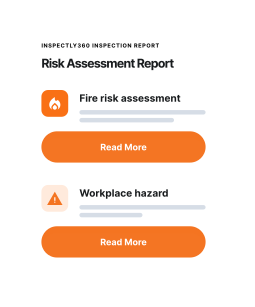


Every team reports differently. Build the report your operations, quality, or compliance leads actually want to read, share it as a branded PDF, and schedule delivery to the stakeholders who need it.


See completion, pass rate, and recurring findings across every checklist and every site, without pulling spreadsheets together at the end of the month.
What changes once injury tracking software is standardised on InspectWrk.






“InspectWrk transformed how we manage site safety inspections. The offline capability alone saved us countless hours. Our compliance rate jumped from 72% to 96% in just three months.”
Sarah Mitchell
Meridian Construction Group
“The AI-powered defect detection has changed how we work. Our inspectors capture photos and the system flags issues we'd have missed. It's like having an expert reviewer on every site visit.”
James Chen
Pacific Manufacturing Co.
“Rolling out digital checklists across multiple projects gave us instant visibility into recurring safety issues. We now resolve critical findings in hours instead of days.”
Olivia Carter
Northbridge Infrastructure
Get started with inspection and audit checklist templates.

Safety inspections with hazard identification, corrective actions, and compliance reporting. Offline capture and evidence.

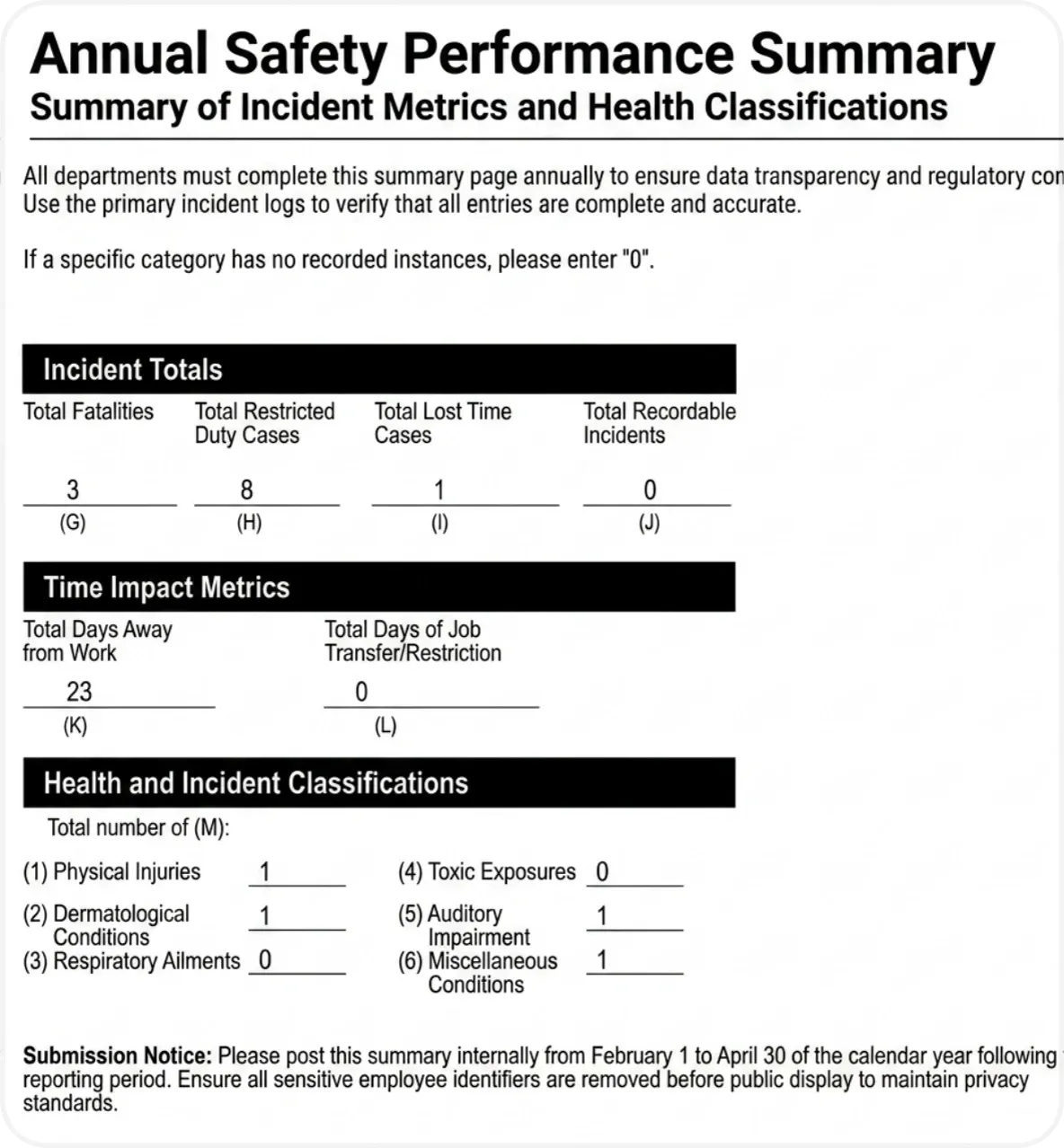
Report incidents and near-misses with details, photos, location, and timeline. Ready for safety or quality review.

Verify arc-flash labels on electrical equipment: presence, visibility, legibility, equipment identification, voltage and incident-energy information, PPE data, and label condition.

Inspect grounding and bonding systems: grounding conductors and electrodes, bonding connections, equipment grounding, continuity, corrosion, and panel connections.
Injury tracking is a focused case of incident management. Incident management handles the full range of workplace events, near misses, environmental incidents, security events, and injuries, whereas this page is built specifically around the workplace-injury lifecycle: the report, the investigation, the corrective action, the lost-time and restricted-duty status, and the recordkeeping that injuries specifically require. The workflows share DNA and connect, so an injury can be handled here while broader events sit in incident management, but the injury-specific fields, classifications, and recordkeeping obligations are what make a dedicated page genuinely useful. If your need is running workplace injuries end to end with the reporting and records they demand, this is the right page; if you need to manage all incident types, that is the incident management solution this connects to.
We build your injury tracking solution on the InspectWrk platform and configure it to your process, rather than handing you a fixed product. Our team scopes how injuries are reported, classified, investigated, and recorded, configures the mobile injury reporting, investigation, corrective actions, lost-time tracking, and dashboards to match, and rolls it out with a pilot site first. Because the platform is built for configurable mobile forms, workflows, evidence capture, and reporting, an injury tracking solution tailored to your process is delivered without custom code. You get software shaped to how your safety team actually handles workplace injuries, supported by our team, rather than the paper forms and spreadsheets where injury records usually go stale.
Yes. When an injury happens, it is captured on a structured mobile form at the scene, with the date, time, location, employee information, witness details, immediate actions taken, and photos, so the record is complete while the facts are fresh rather than reconstructed later. Each injury is then classified consistently and investigated to determine its root cause, which is what turns a one-off event into a lesson. Because the report, investigation, and evidence sit on one case record, nothing is lost between the incident and the follow-up, and the investigation is genuinely part of the workflow rather than an optional extra. Capturing accurate detail at the moment and investigating properly is exactly what makes an injury record defensible to a regulator or insurer and useful for preventing the next one.
Yes. Each injury case tracks its lost-time and restricted-duty status, so a worker's return-to-work progress is current on the record rather than in a spreadsheet someone has to remember to update, which matters for both cost and reporting. The causes found during investigation become owned corrective actions with due dates, tracked to closure, so the hazard that led to the injury is actually removed rather than left in place. Because status and actions sit on the case and roll up across sites, a safety lead can see open corrective actions, current restricted-duty cases, and injury trends in one place. That combination of accurate case status and tracked corrective actions is what moves injury management from recording what happened to reducing what happens next.
Yes. Injury recordkeeping obligations, such as OSHA recordkeeping and equivalent requirements elsewhere, expect complete, accurate, retained records of workplace injuries and the actions taken. Because every injury on the platform carries its details, classification, investigation, corrective actions, and lost-time status with time and author preserved, you can produce a complete injury record on demand rather than assembling it from paper under pressure. Injury data also rolls up into safety trends, so you can see where injuries concentrate and demonstrate to leadership, regulators, or insurers that they are being acted on. The recordkeeping benefit is a direct result of injuries being captured and managed in one place rather than across forms and spreadsheets, and it turns a compliance burden into a byproduct of good injury management.
Last updated: