

Facilities41,000+ downloads
Site Inspection Checklist
Standard site-level inspections for construction, safety, and compliance. Capture conditions, photos, and follow-ups in one place.
- Site
- Inspection

Facilities Management checklists
Library of free facility management checklist templates: safety, cleaning, maintenance, and other facility audits. Find the right checklist and run it digitally on the InspectWrk inspection app.
Search or browse by industry to pick a proven template.
Edit questions, scoring and required photos to fit your sites.
Run it in the InspectWrk app, even offline, or export a PDF.
Sign off and a branded report is generated and shared.
2,656 free templates, ready to use in the app or as a PDF.
Showing 1-12 of 2,656 templates
Standard site-level inspections for construction, safety, and compliance. Capture conditions, photos, and follow-ups in one place.

Complete work orders with checklist items, photos, and sign-off. Track completion and proof of work.

Inspect assets and equipment: condition, location, photos, and maintenance history. Track condition over time.
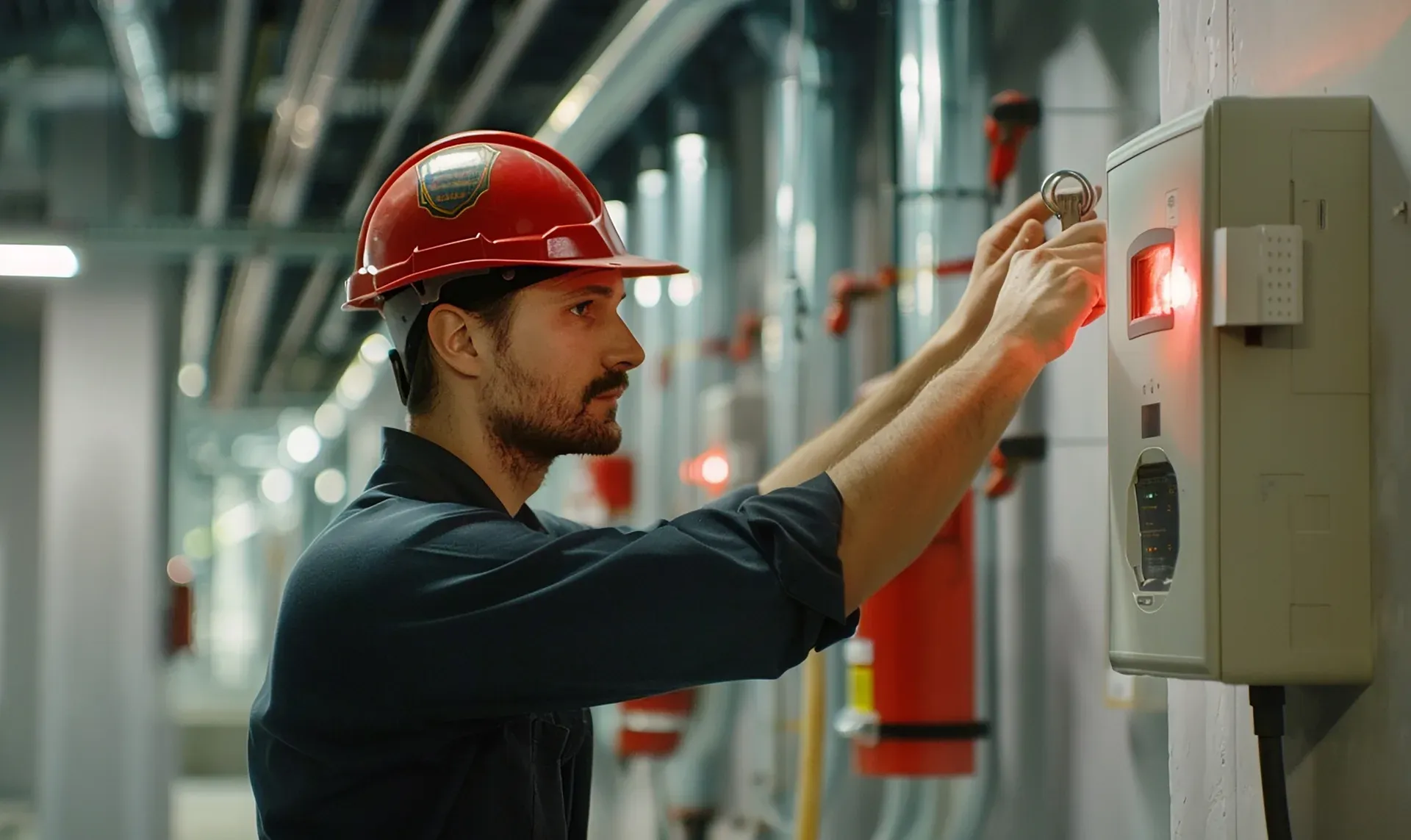
Preventive and corrective maintenance inspections. Log repairs, parts, and condition with photos and follow-ups.

Inspect rooftop HVAC units end to end: filters, coils, belts, fans, motors, electrical connections, drainage, and thermostat operation, with photo evidence and corrective actions.

Inspect the mechanical room as a space: equipment condition, pumps, piping and valves, leaks, housekeeping, access clearances, labels, and safety hazards.

Test UPS battery condition and backup capability: voltage, terminals, temperature, battery health, runtime and backup test, alarms, and test results.
Verify thermostat accuracy and calibration: current versus reference temperature, setpoints, sensor condition, control response, and before and after readings.

Inspect EV charging equipment: charger condition, cable and connector, display and status, electrical connections, emergency stop, grounding, and safety features.
Check VAV boxes and their control operation: damper and actuator movement, airflow, temperature, sensors, thermostat response, duct connections, and BAS communication.

Inspect economizer and outside-air control: dampers, actuators, temperature sensors, control settings, outside-air operation, and airflow, with deficiency tracking.
Document the response to a utility outage: outage confirmation, notification, critical-system checks, backup power and generator status, safety checks, and restoration.
Open a ready-to-use template and customize it for your team.
Every Facilities Management template in one place: 2,656 in total.
A facility inspection checklist is a structured document used to assess, record, and track the condition of buildings, systems, and operational areas in a consistent format. It helps facility and property teams maintain full visibility across maintenance status, pending repairs, upgrades, and contractor performance.
Also used as a facility management checklist form or facility audit checklist, it supports one core objective: keeping sites safe, compliant, and fully operational for occupants and business continuity.
Facility inspection checklists simplify day-to-day upkeep by turning inspections into repeatable, evidence-based routines. They also allow teams to maintain service quality even when managers are not physically present.
Digital facility report template workflows improve accountability by recording who completed what, when, and with what evidence. This creates defensible records for regulatory and contractual reviews.
Strong facility compliance checklist use also supports preventive maintenance, improving asset reliability and reducing lifecycle costs.
Read the case study: How Woodside Homes uses digital checklists to simplify quality audits.
Effective facility governance uses multiple checklist formats by building type, inspection objective, and frequency.
Tiered frequencies improve control and prevent gaps:
Specialized templates target critical systems for focused inspections:
Read the case study: How 10 Fitness simplifies facility audits using digital checklists.
While content varies by property type and objective, most facility management audit checklist templates include core inspection domains for safety, function, and compliance.
Depending on scope, additional checks may include pest management, historical maintenance records, service documentation, and tenant/occupant feedback.
Use this workflow to run efficient inspections and close issues faster:
A facility audit report is a formal record of building condition, safety status, and operational performance. Beyond compliance evidence, it is a decision-making asset for risk control, budget planning, and preventive maintenance strategy.
High-quality reporting creates clarity on what needs attention now versus later, helping teams allocate resources more effectively.
A professional facility report template should follow a consistent, evidence-first structure:
Paper and spreadsheet reporting frequently create operational bottlenecks:
Modern facility teams need faster reporting with stronger evidence quality. A digital facility inspection report template removes duplicate data entry and improves decision speed.
With InspectWrk, reports are generated as soon as inspections are completed on mobile. Stakeholders receive timely updates, corrective actions are assigned immediately, and compliance tracking becomes easier without manual paperwork overhead.
Free facility audit report sample: Here's what an office facility inspection report generated with the InspectWrk app looks like.
Overall, InspectWrk gives facility managers one workspace to schedule inspections, configure checklists, assign corrective actions, and track completion. Field teams can run self-inspections, capture evidence, and share facility report templates instantly to save time and improve service control.
Choose a proven workflow, customize it for your operation and deploy it to your team.
View All Apps FacilitiesRated 4.8
by InspectWrk
Run planned maintenance, HVAC, and building services checks from one app.
 BuildingRated 4.8
by InspectWrk
Building condition and compliance inspections with photo evidence.
 PropertyRated 4.8
by InspectWrk
Move-in, move-out, and routine property condition reports.
 ConstructionRated 4.8
by InspectWrk
Site-level safety, quality, and progress checks for construction.
See your own checklist running in the app in a 30-minute demo.
Book a Free DemoA facilities management inspection checklist should cover the building fabric, safety systems, plant, and the planned maintenance that keeps assets reliable. Daily rounds check cleanliness, washrooms, common areas, and obvious hazards. Safety items cover fire extinguishers, alarms, emergency lighting, escape routes, and the evidence a fire safety NOC requires. Plant and asset items cover HVAC, pumps, lifts, and electrical panels on a planned preventive maintenance schedule, with AMC and statutory renewal dates tracked against each asset. Each finding should carry a photo and a corrective action with an owner and due date. Aligning the checklist to standards such as ISO 41001 means the same inspection that keeps the building running also produces the compliance evidence clients and auditors expect.
The platform schedules recurring planned preventive maintenance by asset, site, and role, so a lift check, an HVAC service, or a fire panel test appears on the technician's app with the asset location and checklist. Completion feeds the dashboard and compliance scores, and a missed visit escalates before it breaches a client SLA. AMC and statutory renewal dates sit against each asset and the system flags them before they lapse, so a contract or a certificate is renewed on time rather than discovered expired. External lift, fire, and HVAC contractors can complete the same digital checklist, so the building owner keeps the master schedule and the audit trail instead of receiving PDF certificates only.
Yes. Many of the assets an FM team inspects, boiler rooms, lift machine rooms, basements, and risers, sit exactly where signal is weakest, so the app works fully offline. Technicians download their assigned rounds and complete checks, capture photos, and raise corrective actions with no connection, and everything syncs to the live dashboard when the device returns to coverage, with timestamps and location preserved. This means the hardest-to-reach and most safety-critical checks are never skipped for lack of a network, and nobody has to re-enter results back at the office. Offline capture is what keeps a multi-site FM programme running on schedule rather than reverting to paper the first time signal drops.
Inspection software keeps fire safety and statutory checks on schedule and produces the evidence in one place. Fire extinguisher, alarm, emergency lighting, and escape-route checks run on digital templates with photos and timestamps, and renewal dates for the fire safety NOC, lift licence, and other statutory certificates are tracked against each asset with alerts before they lapse. When a check finds a fault, a corrective action is assigned and tracked to verified closure, so a hazard is resolved rather than noted. When an authority or an insurer asks for proof, the team produces a complete, timestamped history on demand instead of assembling it under pressure, which is the difference between demonstrating compliance and hoping the paperwork is complete.
Yes. The platform is built for FM teams that manage many buildings, so it scales from a single site to a large portfolio. Each site keeps its own assets, schedules, and assigned staff, while leadership sees one dashboard covering completion rates, open issues, overdue actions, and compliance status across every location. Managers can compare performance between buildings, see which site has the most open hazards, and spot recurring issues across the estate. New sites inherit the standard templates on day one, so standards hold as the portfolio grows. Reports can be generated per building or for the whole estate as branded PDFs for clients, boards, or insurers, replacing the manual coordination that breaks down once a programme grows beyond a couple of sites.
Last updated: